
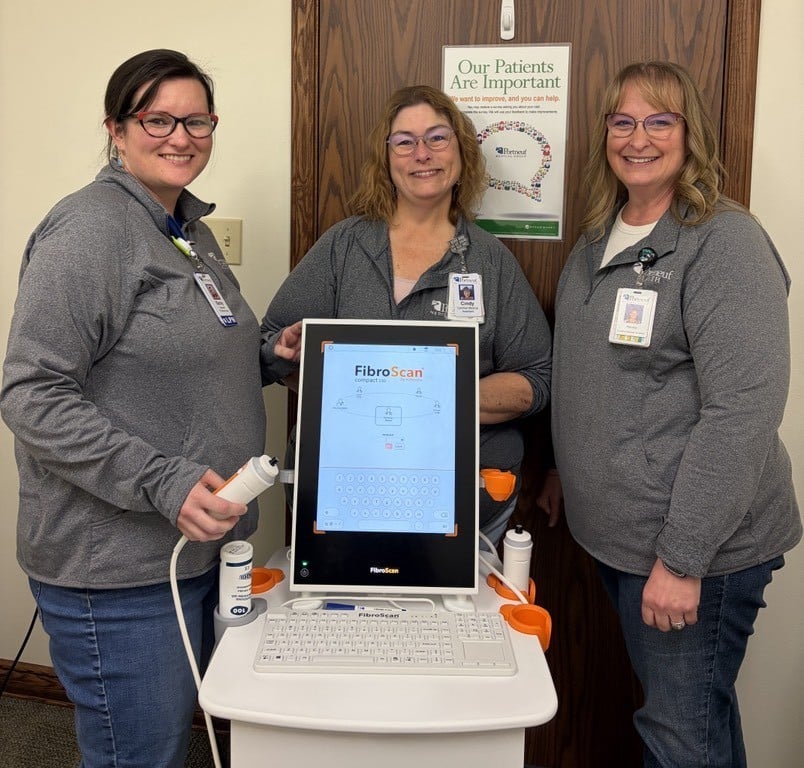
Liver disease affects millions of people worldwide and can develop silently over many years. Knowing the extent of the disease is the first step in fighting it. Previously, a thorough examination of the liver often included a biopsy – removal of a small sample of the liver – involving a local anesthetic before the procedure and pain relievers after the procedure. Portneuf Gastroenterology providers now use a non-invasive, ultrasound-based device called FibroScan to measure liver health.
Your provider may recommend this painless exam if you have a liver condition, such as fatty liver disease, viral hepatitis (hepatitis B and C), primary biliary cholangitis (PBC), primary sclerosing cholangitis (PSC), alcohol-related liver disease, metabolic dysfunction-associated steatohepatitis (MASH), or genetic diseases such as hemochromatosis and Wilson’s disease. These conditions can lead to liver fibrosis, a process in which healthy liver tissue is gradually replaced by scar tissue. If fibrosis progresses, it may result in cirrhosis, liver failure, or liver cancer.
Early detection and monitoring of liver damage are critical because fibrosis can often be slowed or even partially reversed if identified in the early stages.
FibroScan uses advanced ultrasound technology called transient elastography to measure liver stiffness. It works by emitting a small pulse of energy, which may feel like a slight vibration on your skin. FibroScan calculates the speed of this energy to give your provider an immediate measure of the stiffness of your liver, which is important to understanding the overall health of your liver.
FibroScan offers several advantages over the traditional biopsy method:
- Non-invasive: no needles, incisions or tissue samples are required
- Fast and convenient: The procedure is completed in a few minutes and is performed during an in-office visit
- Pain-free: Most patients experience little to no discomfort during the exam
- Useful for ongoing monitoring: Because the exam is simple and repeatable, FibroScan can be used to track disease progression or response to treatment over time
While a liver biopsy may still be needed in certain complex cases, FibroScan is increasingly used as a first-line tool. For questions about the FibroScan device and its use in monitoring liver disease, contact Portneuf Gastroenterology today at 208-232-6616.