
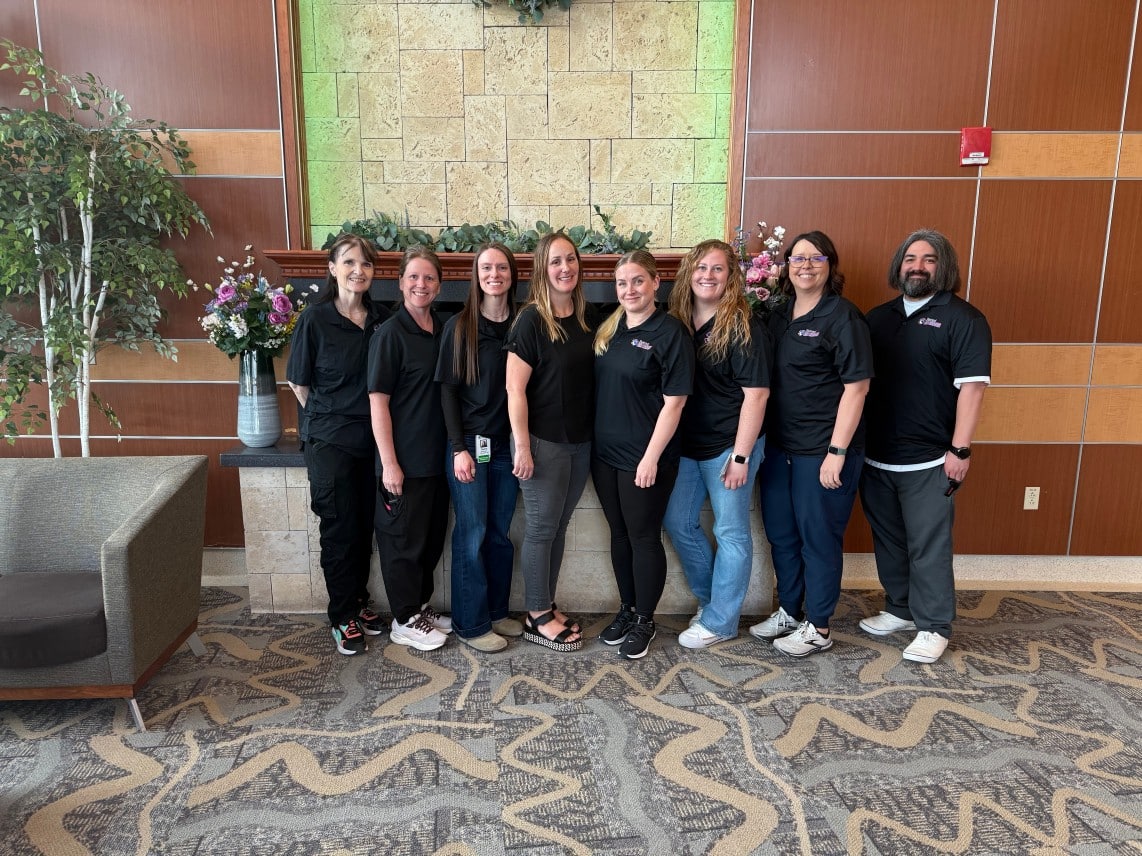
Thousands of babies are born in the U.S. each year, many of them requiring specialized care in neonatal intensive care units (NICU). However, not all hospitals are equipped with the technology and specialists necessary to treat them. In such cases, babies must be transferred to another facility as fast as possible. In southeast Idaho, Portneuf Medical Center’s NICU transport team is ready to help.
Made up of registered nurses (RN) and respiratory therapists (RT), the Portneuf NICU transport team provides interfacility transfers for the neonatal population. The team transports babies by ground ambulance, fixed wing or rotor aircraft, and offers treatments like high-frequency ventilation and central line placement for fluid administration – all while on the go.
Susan Shroll, RN, is a member of the transport team.
“I began my nursing career in med-surg, then moving to labor and delivery and finally to NICU in 2003,” said Shroll. “In 2006, I joined the NICU in Pocatello, Idaho. The position also included transport, and I looked forward to that challenge.”
The NICU had its beginnings in Pocatello as a four-bed unit at Bannock Hospital in the mid-1970s, pioneered by Dr. Roger Boe. In 1975, The March of Dimes gave a grant to the hospital for the first transport isolette and the team completed their first ambulance transport. Shroll recalls her first NICU transfer on the team.
“My first transport was for a set of premature twins born in a rural facility,” said Shroll. “I remember being very nervous and wondering if I would be up to the task. Twins require two teams, one for each patient. Each twin required intubation, and it was here that the team supported me and I had my first successful intubation in the field. It was eye opening to see the coordination that is required to care for each patient and ensure their safety as well as the crew’s safety. Transport is a team sport.”
Today, the NICU transport team consists of 20 trained and highly skilled RNs and RTs. RNs must complete three years of full-time hours in the NICU prior to joining the team, while RTs must demonstrate competency in the NICU prior to joining the team. This can often take up to two years.
Typically, two or three team members are present on each transportation, though this depends on the mode of transfer. Portneuf’s NICU transport team is also a unit-based transport team, which means transport team RNs care for patients in the NICU when they are on transport call.
“When a request for transfer is received and accepted, the team members hand off their assigned patients to other staff and prepare for the transport. The priority is getting the team to the facility as quickly and as safely as able,” said Shroll. “Once the team arrives at the referring facility, stabilization takes place. Depending on the patient’s needs, this can take up to several hours before the team and patient depart for the transfer to our NICU. In some cases, we will arrive prior to the birth of a high-risk infant and provide care immediately.”
In 2018, Shroll was promoted to NICU transport coordinator. Since then, Shroll has helped to develop education and competencies, team dynamics and an outreach program.
“In this position, I have enjoyed seeing team members grow and advance their skills as well as develop a close relationship with each other to meet a common goal of providing high quality, safe care for the smallest of patients,” said Shroll.
But every day presents new challenges for the NICU transport team. Thankfully, Shroll and her team are up to the task.
“In the world of NICU transport, we always experience challenges,” said Shroll. “Our team must often adapt to care for these patients in rural facilities with limited resources, medical equipment and providers. At times, the team must work to stabilize an infant in a nursery that is the size of a closet. Other times, the patient’s condition is much different than what was reported to the team. The only constant in NICU transport is that you never know what to expect and you must be prepared for anything.”
Portneuf’s NICU transport team are no strangers to the unpredictable nature of neonatal care. However, one thing is certain: they are deeply committed to providing exceptional, compassionate care to the youngest, most vulnerable patients in the region.